
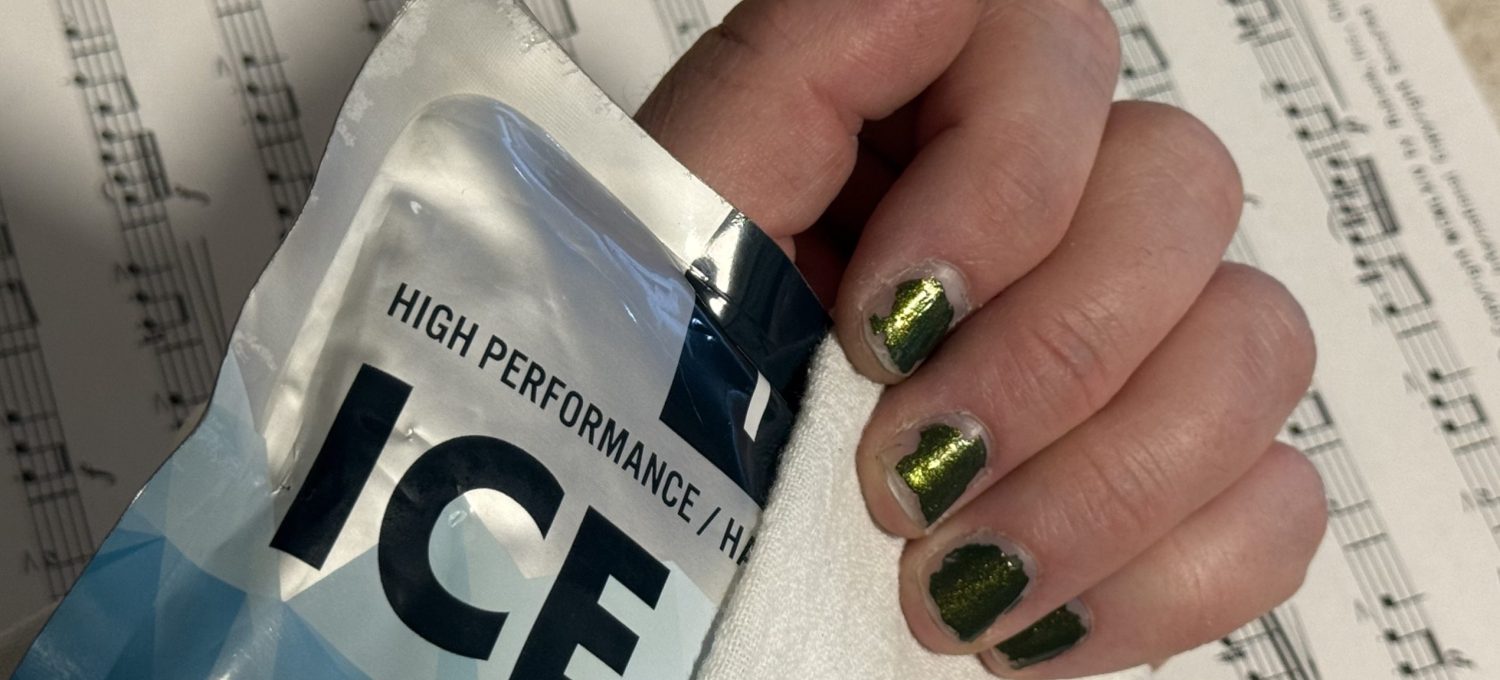
It’s not uncommon to see a musician suffer from injuries related to their playing. In 2017 I also suffered a very serious injury in my right hand that led me to stop playing and interrupt my master studies. When a musician gets injured, it presents an existential threat. Your whole life plan comes into question because everything depends on you being able to play your instrument. My recovery process has been long, meticulous, and demanding, but also somehow rewarding in another way. The lessons I have learned throughout this journey are invaluable and have had a profound impact on my growth as a musician.
Musicians often feel lost, unsure of what steps to take or where to seek guidance when they begin to experience pain, and many questions arise. “Should I rest and stop playing for some days?” “Should I do stretching exercises?” “Should I take some medicine?”
The Pain
Pain is one of the first things musicians notice when a problem related to their playing arises. In fact, pain is actually our friend. It’s a wake-up call, because it’s the way our body tells us that something is wrong and needs to be fixed. Playing through pain is not a good practice because the discomfort continues, and it can progress into a chronic condition (Kertz, 2022, p.9; Tomlinson, 2012, p.1196).
Musicians tend to extend their practice sessions prior to injury, and many of them only seek medical help when they realize that their technique is insufficient to play their repertoire. Additionally, most of the time they compensate by using other muscles not designed for that purpose. The body actually thinks that this is now the way things are supposed to be and will adapt. The body might shift stress from tired muscle groups to other muscle groups in order to do the necessary adjustments, causing these muscles to overcompensate and to become tight and sore from overuse themselves (Kertz, 2022, p.9-10).
When musicians eventually decide to seek medical help, their conditions are well-developed and desperate for help. By this time, they are willing to do anything to get better. No one wants to be in this position, which is also a dangerous one, as normally people don’t take the time to research for a doctor that may be the right one for their case (Liebermann, 2004, p.73). It is also good to have in mind that Muscle Medicine is a relatively new field. As Liebermann also references in his book, You Are Your Instrument, no matter how excellent the intentions of the doctor are, he or she may not know all the answers.
The Recovery Process
The treatment of an injury has two distinct and overlapping phases: the initial stage focuses on alleviating pain and symptoms, known as the healing phase, while the subsequent stage emphasizes a gradual and systematic return to full musical and daily activities to prevent emotionally and physically distressing setbacks (Norris, 1993, p.382,1492-1571). To have a successful recovery, whether you have a mild or a severe injury, it is crucial to pass through these four components (Klickstein, 2009, p.246-249):
1. Obtain expert advice.
2. Follow a treatment and rehab schedule.
3. Transform playing habits.
4. Modify activities of daily living.
Psychological Difficulties During the Process
When there is a serious physical problem that affects the playing, musicians tend to stress and go into panic mode. Most of the time they might tell it only to their teacher and no one else because they don’t want to be seen to have something wrong. It creates a big fear to not be able to play or sing again, and, as a result, to have their career ruined. The tendency is to continue to hide the problem and to feel ashamed of it (Tomlinson, 2012, p.1142-1168).
Tomlinson also wrote in her book, Music From The Inside Out: A Musician’s Guide To Freeing Performance (2012), that sometimes musicians tend to think that having physical symptoms implies that they are not doing something well enough. Consequently, they believe they are not good enough musicians because, “how could something like that have happened otherwise?” Denying the problem can be really dangerous, and it can actually get worse if nothing is done (Tomlinson, 2012).
During the healing process of an injury, depression and psychological difficulties are more likely to occur. If the musician cannot play, he may practice mentally, work on music theory, harmony, solfège, listen to music, read, and enjoy life. You can keep your creativity alive and support your healing process by maintaining a positive attitude throughout the recovery. But if this is hard to do, it’s important to seek psychological help (Klickstein, 2009; Norris, 1993). As Klickstein also reinforces, “In the long run, a temporary respite from full-time playing is unlikely to have any negative effect on your musical development. The time you take off may even inspire personal growth. So, use any rest interval to stoke your love of music.” (Klickstein, 2009, p.249).
My Recovery Process
I wish I could say that it was an easy and quick recovery process, but it was anything but that. A lot of ups and downs, moments without playing at all, frustrating moments when I tried to play the repertoire but without success. I remember myself always being a bit tense while playing. I felt the tension, but since it never stopped me from playing or caused much pain, I never really took care of it.
Fast forward to 2017 when I was preparing for my entrance exams in Brussels. I did the entrance exams in September, and I spent the whole summer practicing for it—or, at least, that was the idea. The first strange symptoms started in July. I remember practicing the Mozart G Major Concerto and feeling that my fingers—in particular the right-hand ring and little fingers—were a bit slower than normal. I thought it was because I was not practicing enough finger technique, and I immediately started to do a lot of exercises. What used to work in the past was not working this time. The movements were not improving, and in fact, they were getting worse, day by day.
I hoped that by going to sleep and waking up the next day, everything would return to normal again. But that didn’t happen. I started researching the loss of finger movement and came across information suggesting that it usually occurs because of accidents or trauma. However, in my case, there was no such incident. Despite this, I decided to seek professional help. I went to a physiotherapist in my hometown, who, although lacking experience with musicians, did her best to understand my situation and help. I believe that the physiotherapy sessions also helped me mentally, providing some sense of calm, even though I didn’t see significant improvements at that time.
In the meantime I continued to play, sometimes using alternative fingerings in order to be able to play the repertoire and to do the entrance exams. Once I passed, I moved to Belgium and started seeking help there. At this point, even holding the flute was starting to give me pain in my hands and arms. The first advice I received there was to stop playing for a while due to the presence of contractures. And that’s what I did. I took a break for two months, and in January 2018, I finally felt ready to hold the flute again and embark on my “comeback journey” to resume playing.
Without following any concrete plan, I knew I shouldn’t start playing for hours all at once. I remember playing only five minutes on the first day, not more than that. My embouchure was “gone,” and I knew I had to start all over again like a beginner flute student. In the following days I played for no more than five minutes at a time with big rests in between. After a week I gradually increased the duration to 10-15 minutes, and so on. It was a really slow process. My fingers weren’t as strong as before, but at least I didn’t feel pain. It was really difficult to do some passages with the little and ring fingers, but I arranged some alternative fingerings, and I chose some easier repertoire to be able to continue playing. I even did some auditions, competitions and orchestra projects in this condition. I kept attending physical therapy sessions, but eventually, I reached a stage where I believed there would be no further improvement.
I realized that to be able to play some passages, I was doing some strange movements with my hand that did not help at all to further improve my condition. One day, when my flute almost fell from my hands because of my bad posture, I decided I had to stop playing again. This was right before the Covid pandemic started. I stopped my master’s program, and decided to finish it only to a point where I could play anything without a problem.
I returned to Portugal due to the pandemic and began organizing my practice sessions more effectively, placing a special emphasis on my recovery. I incorporated a proper warm-up and cooldown routine into my practice with shorter playing intervals and extended breaks. I focused on easy pieces as well as sound and finger exercises. As this was a slow recovery process and I needed to see improvements, I started to use a metronome and to write down the beats per minute (BPM) in my agenda every day. With the finger exercises, I started with the metronome in a comfortable tempo (really slow) and I was gradually increasing the BPM every few days. There were days I felt almost a waste of time because the feeling was, it was not improving at all, but also other days gave me hope. Observing my daily entries in my agenda, I could see that despite the slow progress and occasional setbacks, my finger technique was improving in the long run.
The world was going through a pandemic. I was, fortunately, at home in a safe place, and like most of people, without much to do. Besides practicing the flute, I also dedicated time to expanding my knowledge about injuries, exploring music, and participating in online masterclasses and workshops. Although it may sound a bit self-centered, I felt that the restrictions imposed during the lockdown helped me mentally to calm down and continue my recovery process without much external pressure. Unfortunately, everything had come to a halt with closures and limitations in place.
Months passed, and my hand improved and reached a point where I thought I could play in concerts for a public audience, though not at a high level. It was, however, good enough to be able to teach. I was okay with that because I felt I had done everything I could. In the beginning of the process, I even thought I would never be able to play again. During that year, I even started working in a non-music-related field. Nevertheless, I decided to visit one last osteopath recommended to me by a family member. By that time, four years had passed since the first symptoms appeared, and I wasn’t expecting further improvement. The hope had vanished.
During the first session, I shared my story with the osteopath, and he was surprised by the journey I had been through. Similarly to the previous therapist I had seen before the pandemic, he said that my injury was in the cervical area rather than directly in my hand and started immediately to work on it. He also inquired about my mental state because he imagined that it must have been a challenging process. I thought by this time I was strong enough to speak about everything I had been through, but in that moment, I immediately started to cry, and he explained to me that I cannot reach the physical level I want if I don’t take care of my mental health as well.
This was, in fact, the turning point for me. The week after that, I went there again, and then every two weeks. I couldn’t believe it when I started to see and feel much more freedom and movement in my fingers. After some months I realized I was able to play pieces I was playing before the injury started. Eventually, I decided to schedule a lesson with my teacher in Brussels, retake the entrance exams again, and finally finish my master’s degree.
Nowadays I’m doing Pilates weekly to help take care of my posture and prevent further injuries, and because I believe every musician should have physical support similar to athletes. I still have some minor issues with my posture that I want to improve, but overall, if almost seven years ago, when the injury started, someone had told me that I would go through all of this, I would, of course, immediately panic and think that I wouldn’t be able to endure it.
In the end, what musicians need, when recovering from an injury, is a proper medical accompaniment, and hope—lots of hope and patience. That’s why I wanted to write about my story. If it gives hope to someone who is going through a similar process, it has reached his purpose.
Bibliography
Horvath, Janet. Playing (Less) Hurt: An Injury Prevention Guide for Musicians.
Mineapolis, Minn.: Janet Horvath, 2009.
Kertz D.C., Randall. Injury Prevention & Management For Musicians: The
Wind & Brass Player’s Guide. Worclaw, Poland: Randall Kertz, 2022
Klickstein, Gerald. The Musician’s Way: A Guide to Practice, Performance,
and Wellness. New York: Oxford University Press, Inc., 2009.
Lieberman, Julie Lyonn. You Are Your Instrument: The Definitive Musician’s
Guide to Practice and Performance. New York: Huiksi Music, 2004.
Norris, Richard. The Musician’s Survival Manual: A Guide to Preventing and
Treating Injuries in Instrumentalists. St. Louis, Mo.: MMB Music, 1993.
Tomlinson, Charlotte. Music From The Inside Out: A Musician’s Guide To
Freeing Performance. UK: CreateSpace Independent Publishing Platform, 2012.
Türk-Espitalier, Alexandra. Musicians in Motion: 100 Exercises With And
Without Instrument. Germany: Musikverlag Zimmermann, 2016.