

When playing the flute, we often encounter challenges when it comes to producing sound, let alone good sound. Our instruments don’t provide us with resistance to help control the flow of air, as is the case with reed or brass instruments. So we rely more on our bodies for air control, similarly to how singers use their bodies. However, one major difference between the flutist and the singer is that tone production in singing comes from the vibrations of the vocal folds as air moves across them, creating a similar resistance for the air that reed and brass players experience when blowing against a vibrating reed or buzzing lips. In flute playing, we need our vocal folds to stay open and released, allowing the air to flow freely from the lungs to the instrument. So then, how do flutists create air resistance so that all of the air doesn’t just escape into the atmosphere? With the lips, of course! We shape and move the lips to direct the air across the back edge of the embouchure hole, allowing the air and instrument to vibrate to produce sound. But there’s so much more to it than just pointing the air and blowing, isn’t there? So how do we take that sound and make it a good, consistent, beautiful tone? We have to create space to allow our tone to ring out, not just into the space around us but also into the space inside our bodies.
As wind musicians, not just flutists but all wind instrument players, we rely heavily on our bodies to take in air and then control that air as it moves from our lungs and through our instruments. When we rely too heavily on one area of our body or another for this task, we often create excessive and unnecessary tension in that part of the body. Very frequently for sound production, that area tends to be the mouth and jaw. Reed players may find themselves biting down too much on the reed and mouthpiece. Brass players may catch themselves also clenching the jaw or pushing the lower teeth forward or pulling in back to direct the air. As flutists, we sometimes find ourselves taking similar steps to direct the flow of air from the lungs, through the mouth, and to the lips. In doing this, we may be creating the feeling of air resistance needed to control the air flow, but we’re also creating tension in the jaw, tongue, and throat. Additionally, we’re also shrinking the open resonating spaces inside our body that can help us to create a beautiful tone: the oral cavity, the back of the throat, even our sinus cavities. This tension, particularly in our throat, also reduces the amount of air we are able to use in our playing and takes away the ability of our lips to effectively control the direction and flow of air into the flute. Tension anywhere will always lead to more tension elsewhere in the body, but tension in the jaw and throat can be particularly problematic due to the proximity to the neck and spinal cord, slowing signals coming from the brain to other parts of the body – almost like driving with the parking brake left on. These areas of tension will most certainly have a negative effect on our ability to produce a beautiful and consistent tone on the flute.
CONSTRUCTIVE REST
So how can we work to release this tension and create space for our sound? First, you need to identify where the tension lives inside your body. One way to do this is through constructive rest. Lying on the floor in a semi-supine position (if you cannot get up and down from the floor easily, you can sit in a chair and rest your forearms on your legs, begin sure to keep a neutral spinal position) with your knees bent and up toward the ceiling and your hands resting on your abdomen. Breathe naturally and check in with your body, particularly the areas around your head and neck. Do you notice any tension? Any pain? Are some areas more or less tense than others? Are there particular areas that have no tension or pain at all? Just observe for a moment, breathing naturally. Now actively zero in on areas where you find tension and give your body permission to release it. Allow your body to move and dynamically let go of any unnecessary tension it may be holding on to. Take your time and do this often, always checking in with your body first and then actively releasing as much tension as you can. And be patient with yourself. The tension didn’t present itself overnight and it’s not going to all go away overnight either.
PLAY AND OBSERVE
Another way to identify where tension is living in your body is through awareness while you’re playing your flute. During your daily warmup or at the start of any practice session, take a few minutes while you’re doing scale exercises or long tones, something you can do on autopilot to allow your awareness to move to your body, and just examine where you might be experiencing tension while you’re playing. How much space do you have between your top and bottom rows of teeth? Is your tongue low or high inside your mouth? Does it move freely and easily as you play? How freely are your lips able to move? Does your jaw move with your lips or are they able to move independently of one another? How open does your throat feel? Do you notice any extraneous throat sounds (grunting, humming, etc.) while you play? Are your shoulders high or low? Do they move freely or are they locked in place? Are your arms and hands able to move freely? All of this is good information that can help you to pinpoint and release any tension that may be affecting your tone and other areas of your playing. Once you’ve identified as many areas of tension as your awareness will allow you, take a moment for some constructive rest in an effort to release some of the tension. Then go back to your warmup and let’s focus specifically on the areas around the face and throat.
SPACE INSIDE YOUR BODY
Choose your favorite long tone exercise and as you do it, notice how much space you have inside your mouth. Try adding some space between your top and bottom teeth as you play. What happens? You may notice, especially in the second and third octave, that you lose a bit of control over the register in which you’re playing. This is normal to start. When you drop your lower jaw, you will obviously notice an increase in the space inside your mouth. What you might not notice at first is that your throat will also open up a bit, allowing air to flow more freely. Put your flute down for a moment and place a hand on your throat, feeling for the movement of your larynx, which houses your vocal folds. Now move your lower jaw and notice how the larynx moves with it. When you drop your jaw, the larynx drops as well, opening your throat in a very natural way and allowing for uninhibited airflow. Often when we hear our teachers tell us to open our throats, we attempt to do this by visualizing an outward expansion of the throat and neck. This image often leads to a different kind of throat and neck tension, forcing and holding the muscles in an outward direction. However when the larynx is able to move down rather than stretch outward, the throat opens the way it was designed to do so and allows air to move more freely. This openness in the mouth and throat also creates a resonating chamber inside our body, allowing our sound to not only ring throughout the space around us, but also throughout the spaces in our body – similarly to the way the sounds of string instruments and pianos resonate inside the open cavities of the bodies of the instrument before ringing out into the hall.
ENGAGING THE LIPS
Now that we’ve released some of the tension in our face and throat and are allowing for the uninhibited movement of air, we have to figure out how to control that flow using our lips. While the lips already play a huge role in sound production for the flute, they probably haven’t been working to their fullest potential if other areas of tension in the body have been doing most of the heavy lifting. This isn’t to say that we want to create tension in the lips, but rather that we need to train our lips to do the work of directing and finessing the airflow into the embouchure hole. For this, I like to use these harmonic exercises from the Suzuki flute method, but you can use any harmonic exercise of your choice.
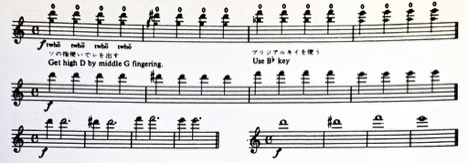
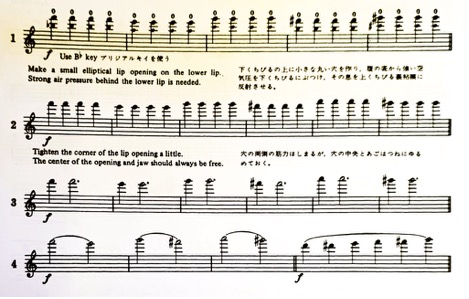
Play these exercises slowly, progressively, and often, adding a note or a line only once you feel comfortable with the previous note or line, and giving your lips adequate time to adapt. Work to keep space between your top and bottom teeth as you perform the exercise. If the register wants to drop on you, think of blowing more along the moist inner part of your bottom lip and keeping the upper lip engaged just enough to support the direction of the airflow. If your lips buzz like a brass player, then take a moment to release some of the pressure in your lips and slow the exercise down to allow yourself time to find the right amount of muscle engagement in and around the lips, all the while keeping space between your top and bottom teeth and allowing the sound to resonate throughout the spaces you’ve created in your body.
Having a beautiful tone on the flute isn’t as difficult as it sounds, but we frequently find ourselves working against nature, often stemming from a mistranslation of instructions from a teacher or clinician or something we may have read in an article or method book. It’s not that the information is incorrect, but as teachers we often forget that the words we say to ourselves or that resonate with us as individuals may be interpreted differently by our students or other flutists. We need to ask ourselves what the goal of a particular instruction is and how our bodies can take the necessary action in our own way. Having a basic understanding of the body and how it works can demystify confusing words and help us to apply those words to our own situations. In other words, when your teacher told you to open your throat to open your sound, what they were trying to portray was the creation of space for your tone. Now all you need to do is figure out how to create that space in your own body. Once you can achieve this goal, your sound will blossom and your palette for painting sound will be filled with endless possibilities.