I’ve been thinking a lot about clavicles this month, as my oldest daughter required surgery to put the three pieces of her clavicle (collarbone) back together after a relatively boring snowboarding fall.
1) The official name is “clavicle” and you have two, one on the left and one the right side.
2) The clavicle is a unique S-shaped, horizontal long bone acting as a strut between the shoulder blade and sternum. I learned from our orthopedic surgeon that even if a fractured clavicle like my daughter’s was able to heal on its own, the length of the clavicle would be too short to preserve movement of her arm up in front and over her head. Part of the clavicle’s function is to provide enough length so that the humerus (upper arm) and scapula (shoulder blade) and can move around the ribs.
3) In Latin, “clavicula” means “little key” and this name was used because the bone rotates like a key when the scapula and upper arm move.
4) The “collarbone” name comes because of its close proximity to the collar of a shirt.
5) Clavicles are the only long bones in the human body that lie in a horizontal position.
6) Due to its position, the clavicle is the one of the most frequently broken bones in the body. It fractures in response to falls onto the shoulder or outstretched arm. According to our surgeon, the usual place where clavicles fracture is in the middle of the shaft, where the bone is thinnest.
7) The clavicle is often the first bone to start ossifying (turning from cartilage to bone) in a fetus, but the last to finish growing, often not fusing until a person is in their early 20s.
8) According to our surgeon, the clavicle has a great blood supply and often heals very well, especially in younger people.
9) The clavicle acts as a protective, bony bridge for important nerves and blood vessels traveling from the neck to the shoulder. The nerves and blood vessels go between the top rib and the clavicle.
10) Evolutionary Presence: In mammals, fully developed clavicles are typically only found in species that use their forelimbs for grasping, climbing, or flying (like primates and bats).
11) Many times, clavicle fractures are not surgically repaired. If the two pieces are not too displaced, they eventually heal, but it takes a long time and is very painful. Every time you move or breathe, the bone pieces are shifting. You spend a lot of time in a sling, sleeping in a recliner because it’s too miserable to try to lie down in a bed.
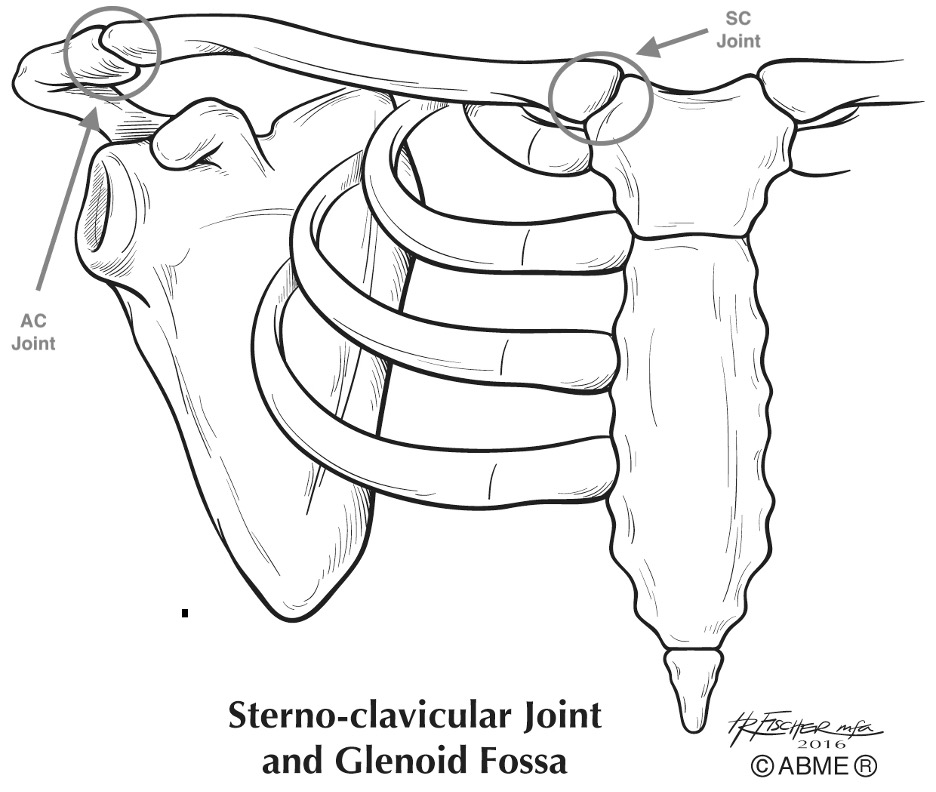
12) There are two joints for each clavicle. The medial (middle) end of the clavicle meets the sternum (breast bone) and forms a joint called the sternoclavicular (SC) joint. The lateral (outside, closest to arm pit) end of the clavicle meets the acromion of the scapula and is called the acromioclavicular (AC) joint. In my reading, the SC joint is generally very stable, and the clavicle tends to fracture before there is a dislocation at the SC joint. The AC joint is less stable. In my kid’s case, both of the joints were intact.
13) There are six different muscles that attach onto each clavicle; two attach to the lateral part of the clavicle and four attach to the medial part. The lateral muscles are the trapezius and the deltoid. Both of these are major arm movers. The four medial muscles are the sternocleidomastoid (connecting skull to clavicle), pectoralis major (connecting ribs, clavicle and humerus), subclavius (connecting first rib and clavicle) and sternohyoid (connecting hyoid bone to sternum, right near the SC joint).
So what????? We’ve got a situation where this relatively superficial bone impacts the function of skull, hyoid bone, ribs, shoulder blade and humerus (upper arm). Without the stability of the clavicle, the entire arm function is compromised. In my daughter’s case, none of these muscles were pulled away from the bone fragments. So… the bone fractured before the joints or muscle fibers were impacted. I didn’t realize those structures were so strong in comparison to the bone itself. If the muscle attachments were torn, the surgeon would have repaired them during the surgery.
Again – So what? Why do we care about our clavicles as flutists?
Well, the SC joint, formed between the sternum and the clavicle, is the only bone-to-bone connection between our arm and the rest of skeleton. This is where your arms are moving from!!! I wrote an entire article called “Missing Pieces of the Whole Arm (Sept 2018)” [https://thefluteexaminer.com/missing-pieces-of-the-whole-arm/] about this and how it impacts flutists. Check out this article and give your un-fractured clavicles some love!