

Twenty years ago, I decided I wanted to buy a bicycle. I had just settled into a new home in a small town that has a paved bike path running right through the middle. I did my “research,” i.e. I looked up a lot of things on the internet and filled my head with information, and then I marched into the local bike shop and started peppering the salesperson with questions, babbling away about circumference, weight, gear ratios, and the like. After a couple minutes of this barrage, the owner of the shop, an older gentleman, came over and planted himself firmly right in front of me, and rather sternly said, “young man, you need a kiss!” Stunned, I took two steps back, but then he smiled and said, “look, K.I.S.S.: Keep It Simple, Stupid!” I am certainly not advocating calling anyone stupid, but the exchange really stuck with me as he was right. He proceeded to ask me a couple basic questions such as where will you be riding, and what is your experience level, and I walked away with exactly what I needed. Not only did he give me a valuable way of looking at the world, but he likely saved me lots of money because he could have used my befuddlement to steer me into buying something elaborate and expensive that I did not need.
When it comes to learning flute fundamentals like tone, I believe that simplicity is essential. I have an entire bookshelf full of tone studies books, and, of course, the amount of information available on the internet, both expert and otherwise, continues to grow exponentially. It is easy to tie yourself in knots with too much information. Adult learners are highly susceptible to this trap; we often overthink, overanalyze, and in our zeal to improve, we seek as many solutions as possible. Another way to think about this is to apply the Zen concept of Shoshin or “beginners mind,” – approach learning with openness and no preconceptions. In other words, try to think like a pre-teen student; just get in there and try things, and try them with a sense of wonder and excitement instead of trepidation and hesitancy.
There are three basic exercises I use with students of all ages that are ready to learn about tone. They create a foundation that one can build on with so much more, but they also stand alone as a simple routine you can always draw on for improvement. The three are almost embarrassingly simple: a harmonic exercise, long tones, and playing familiar melodies. I will briefly outline each of them here. Despite my grumblings about internet content, I am gearing up to make a series of descriptive YouTube videos about this topic in the fall, so stay tuned if these are of interest to you as playing and talking about them will give far more depth than simply describing them.
- Harmonics
I warm up with this simple routine every time I play. You gain a lot of benefits from playing harmonics, and the two most important are increased embouchure flexibility and learning consistent and relaxed use of the air.
Start on C in the middle register and change the air direction and speed so that you move to the octave above, and then a fifth above that, and then reverse this back to the starting note. It is important to do this in one continuous slur, and to glide as smoothly as you can between the notes. Make sure there are no bumps and that you are not squeezing with your lips or anywhere else; this is a really good way to work on eliminating tension. Once you complete this and it is smooth, move down a half step and repeat, and keep moving down until you reach your lowest comfortable note. The lower you go, the more partials you can reach, but make sure that you are not using too much force or unwanted tension to do so.
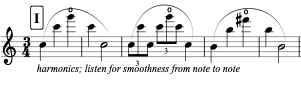
Once you are comfortable and confident gliding up and down through each harmonic series, you can elaborate on this by moving back and forth between the partials, as shown in the study. Again, make sure it is slurred, smooth, and always relaxed.
It’s as simple as that. Be patient; the tonal benefits from practicing harmonics every day really show in the long term, and if your first few attempts are tense and somewhat challenging, stick to it. Do not overthink, just keep trying.
- Long Tones
Simple. I call this my “modified Moyse” because it is a slight variation of the Moyse study that every flute player learns at some point. Instead of a two-note chromatic pattern, I play three notes. Start on B in the middle register, smoothly glide down three notes chromatically, and repeat. Then move down a half step and do it again and keep moving down until you reach the bottom. Go back to the starting note and go up instead of down. That’s it.
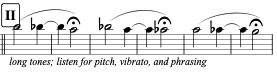
This is an ideal time to keep things as simple as possible and focus on one simple goal: make a beautiful sound.
One should never be bored with this simple exercise. It is a blank slate you can use for so many things. Once you are content with your basic tone, experiment with different dynamics, different colors, different phrase shapes, varied vibrato width and speed, different releases, and so on.
But again, let go of the chatter in your mind. Let go of things like, “I need to move my soft palate just so,” or, “use these muscles to increase air speed,” and just make a beautiful sound. If it is not quite what you want, keep experimenting with small changes until you begin to open up.
- Lyrical Melodies
This is probably more important than the previous two. Find simple melodies that you like to play, especially those that have emotional resonance for you, and play them. My students bring me all kinds of interesting things—Disney tunes, video game music, Anime tunes, favorite hymns, songs from musicals—and we use those to explore making great sound and other musical concepts. If you are more engaged with the music on a personal level, you are less likely to flood your mind with chatter and abstract ideas. In other words, you play like you mean it, and this almost always opens up a far better mindset for finding—and remembering—what you need to do to create beautiful tone.
My favorites are like comfort food. I like to play various arias from Donizetti’s Lucia; it is such a glorious flute part, and I was fortunate to play it early in my career in one of my first “real” jobs. I also love to play the simple tune “Moon Over the Ruined Castle” from Suzuki Book one. Some days I use that to work on all sorts of details in vibrato, color, and the like, and will challenge myself to transpose it to various keys, but some days I will just let go and play it from the heart, and suddenly I am a seven-year-old kid again just having fun and finding joy in making music for the first time. I usually benefit the most from those days.
One last bit of advice that I share with all my students: to maximize improvement in tone, practice your tone exercises twice a day. We all warm up with tone studies but then move on to all the other work we need to do. That is a good start, but you will gain even more if you do this, and then after playing something else for 20-30 minutes and you are really in the zone, hit the pause button, stretch a little and take some slow, deep breaths, and play some long tones and other such. You are going to be completely warmed up by then, and likely in a good head space to really engage and enjoy working on sound, so this will be an even more productive session than your warm up time.
Keep it simple. Make a beautiful sound. Be persistent.